
If you live outside the United States and wish to purchase a kitten from Savannah Cat Breed, you must first check with the authorities in your country to be sure serval hybrid cats are allowed. If so, check to see if any generation of hybrid cat is disallowed. Some countries place stipulations on the earlier generations. The easiest way to check hybrid cat import status may be by calling your country’s Embassy in the United States or by checking with your federal vet.
Savannah Cat Breed has been placing kittens in homes internationally for more than ten years. The process is more challenging than placing kittens within the U.S. and the steps involved take additional time and expense. How much time and costs depend on the country to which the kitten is being sent.
Countries that Savannah Cat Breed has sold kittens to are highlighted below in turquoise:
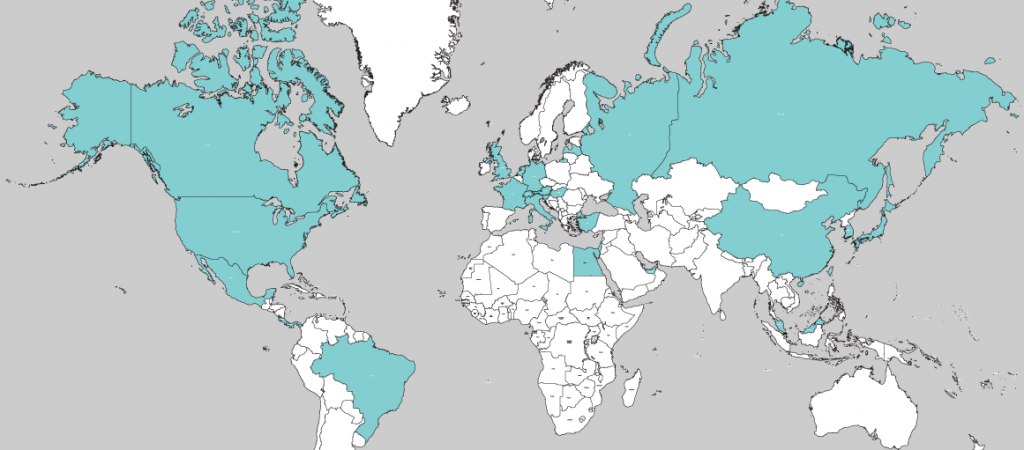
The following will give you an idea of the process:
The CITES permit
Savannah Cat Breed must initially obtain a CITES export permit regardless of which country receives the kitten. This step alone can take from four to twelve weeks. While the application is simple, the biologists processing permits are so backed up it has recently been taking eight to twelve weeks to receive the permit. In order to save as much time as possible, Savannah Cat Breed mails the application by Express mail to the officials along with a return prepaid Express envelope.
Once the CITES export permit is received, it is scanned and emailed to the purchaser. At that time the purchaser has to apply for a CITES import permit. Not all countries, however, require a CITES import permit. Canada, for example, does not require a CITES import permit. To find out your country’s requirements, go to www.cites.org. Please ask your country’s officials 1) If Savannah cat USA is allowed into your country and if there are any generation restrictions 2) If Savannahs require a CITES import permit. It generally only takes a couple of weeks to receive the CITES import permit.
Rabies Vaccination
Each country differs in regulation. Some allow kittens under 12 weeks of age into the country without a rabies vaccination. Some demand rabies vaccination regardless of age. Others require kittens not receive the vaccination until 12 weeks of age or older. Moreover, some countries admit kittens the day after receiving the vaccination while most necessitate a kitten not travel until 21 to 28 days after the vaccination is given.
Rabies-free countries have radically different regulations. For example, kittens may be vaccinated at 12 weeks and blood pulled at 16 weeks for a rabies titre test. If test results indicate an acceptable antibody level, the kitten must remain at Savannah Cat Breed under our care for six months from the date the blood was drawn before being allowed to travel. Contact your local or state vet to find out the rabies regulations for importing animals into your country.
International Health Certificate, Microchip & Carrier Regulations
Savannah kittens must have an International Health Certificate to travel out of the country. Most countries require the health papers be endorsed by a USDA Federal Vet. Most also require microchipping. Airlines require shipping the kitten in a carrier larger than needed for domestic travel. The shipment of your kitten has to be declared to US Fish & Wildlife. They have to inspect the shipment and endorse the CITES export permit before the kitten is sent.
Requirements by Country
Canada
Canada is one of the easiest countries into which a kitten may be sent. While a CITIES export permit is required for F1-F4 generations, the import permit is not. A kitten under 12 weeks of age can be sent without rabies vaccination. A kitten over 12 weeks must be vaccinated, but can be shipped the day following vaccination. Microchipping and federal vet endorsement of the International Health Papers are not necessary. Shipping into Canada during the winter months is challenging, however. Few airlines fly pets into Canada during this time, and usually only into the major airports. Shipping itself is usually about $250, making total expenses to get a kitten into Canada $800 for F1-F4 kittens and $650 for F5 and further removed kittens.
China
A CITES import permit is not required. A rabies vaccination is required with a 30 day waiting period after vaccinating before shipping. China has some restrictions on what generations are allowed and this differs by region. Some regions also require the animal be spayed or neutered before being allowed to enter the country. There is also a requirement that the buyer must travel with the pet or the pet must be shipped within two weeks of the buyer traveling from the US. There may be a quarantine period upon arrival. This also varies by region.
Japan
A CITES import permit is not required. Microchipping is required. A rabies vaccination is required at 90 and 120 days of age. After the second rabies vaccination blood must be drawn for a rabies antibody titre test. After the blood draw there is a 180 day ‘quarantine’ period that the kitten has to remain with us at Select Exotics. Advance notification to Animal Quarantine Services in Japan has to be given no later than 40 days prior to travel. Shipping and associated expenses are approximately $1,200. There is an additional quarantine boarding fee as well.
Most EU Countries
A CITES import permit is required for F1-F4 generations. Microchipping is required. Rabies vaccination at 12 weeks of age is required with travel 21-28 days after vaccinating. EU Countries all have their own EU Health Certificate, specific to each country, which has to be endorsed by the USDA vet and accompany the kitten, in addition to the standard international health certificate. Kittens being shipped by themselves are considered a commercial shipment and therefore have to visit the vet and have all paperwork endorsed within 24 hours of travel. Shipping and associated expenses to airports that we are able to ship into without a shipping agent will run approximately $1,300 to $1,500. Shipping expenses into airports that will require the use of a shipping agent will run approximately $2,000.
Russia
A CITES import permit is not required. Microchipping is required. A rabies vaccination is required with a 30 day waiting period after vaccinating before shipping. Russia requires the rabies vaccination be an inactive form. This form can be given at 12 weeks of age, then 30 days later the kitten can travel. The health certificate must be issued within 5 days of travel. Currently the only airlines that ship pets into Russia require the use of a shipping agent. With this added expense the cost to get one kitten into Russia is approximately $2,000. If two kittens are being sent at the same time the cost is only a couple hundred dollars more.
Qatar
A CITES import permit is not required. Microchipping is required. Rabies vaccination at 12 weeks of age is required with travel 4 weeks after vaccinating. Qatar also has an import permit that the buyer is responsible for acquiring. Shipping and associated expenses are approximately $1,200.
South Korea
A CITES import permit is not required. Microchipping is required. The individual can travel without a rabies vaccination if under 12 weeks of age. If the individual is over 12 weeks of age it must be vaccinated for rabies and a blood titre test must be performed afterwards. It is my understanding that because of the wild heritage Savannahs require some sort of import permit or must be imported by a person that has been approved to import Savannahs. There is also a mandatory quarantine period, which I believe is one week. Shipping and associated expenses are approximately $1,300.
Taiwan
A CITES import permit is not required. Microchipping is required. Rabies vaccination at 12 weeks of age is required. 2-3 weeks after vaccinating for rabies the kitten must have a rabies antibody titre test performed and then must wait 180 days after the test before traveling. At least 30 days before arrival the buyer is responsible for applying for an import permit. There is a mandatory 21 day quarantine period upon arrival. Shipping and associated expenses are approximately $1,300. There is an additional quarantine boarding fee as well.
Turkey
A CITES import permit is not required. Microchipping is required. Rabies vaccination at 12 weeks of age is required, followed by a 4 week waiting period before the kitten can travel. Turkey has its own health certificate that is required in addition to the standard international health certificate. An import permit is required and is the responsibility of the buyer. Shipping and associated expenses are approximately $1,300.
UAE/Dubai
A CITES import permit is not required. Microchipping is required. Rabies vaccination at 12 weeks of age is required, followed by a 3 week waiting period before the kitten can travel. An import permit is required and is the responsibility of the buyer. British Airways is the only carrier that I have found to fly pets into Dubai. They charge more than the other airlines to ship pets, so the shipping and associated costs are approximately $1,800.
United Kingdom
A CITES import permit is required for F1-F4 generations. Kittens have to be micochipped at 12 weeks of age, followed by a rabies vaccination on the same day. Kittens can travel after a 21 day wait period from the time the rabies vaccination was administered. An EU Health Certificate is required, as well as an International Health Certificate. Kittens also have to be treated for ticks and tapeworms by a vet before they can travel.
| Things to Consider | Price |
|---|---|
| CITES export permit & express shipping | $150 |
| Vet Expenses (rabies, mc & international health papers) | $150 |
| Federal Vet Endorsement | $75 |
| Fish & Wildlife Inspection | $165 |
| Carrier | $60 |
| Shipping (depends on the country being shipped to) | $450 - $800 |
| Total | $1,050 - $1,350 |